Thursday, September 6, 2012

"Conversations with Clothesline Principals" for Sarasota Visual Art


Pamela Beck
by Pamela Beck
People have a lot of questions about the newly expanded Clothesline Gallery and Boutique in Sarasota since it reopened six months ago. Is it more of a gallery or boutique? (Both, plus); Is it run by twenty-somethings? (Yes, and well.); Do you have to be a Ringling College student to show there? (Not at all); What are they actually trying to do there that’s different from regular galleries and stores? (Think collaborative, community and evolving.)
I spoke to Clothesline Owner/Creative Director, Austin Kowal; Manager, Van Jazmin and Gallery Director, Michael Bailey, to learn more about each of them, their vision for Clothesline and how they have merged their talents as artists/ entrepreneurs to bring fresh ideas to the Sarasota community.

Austin Kowal portrait by Scott Braun
Austin Kowal
1. What is your position at Clothesline and what do you do?
AK: I am the owner/creative director of Clothesline. My focus with the business is screen printing, which branches off into two areas. One is commercial screen printing for businesses, schools, charities and many other organizations. The other side of screen printing for me, is highly creative- producing art on t-shirts for the store, making screen printed posters and collaborating with local artists.
2. Please explain what Clothesline offers.
AK: Our flagship store is located in the Historic Burns Square District of Sarasota, FL. We feature local art for monthly exhibits, carry hand-selected brands in the boutique, and produce limited edition apparel with local artists for our Clothesline brand.
3. You work with a few colleagues. What individual traits do you bring to Clothesline?
AK: I come from a family of art/antiques and an artistic lifestyle has always been encouraged. With my background I have a keen eye for balance, design, and quality work in general which helps guide me in my role as creative director.
4. You’re an artist and entrepreneur- how do you balance or fuse the two?
AK: I never thought I would be as happy as I am working for a living! With Clothesline it started out as a purely artistic fun project, and then over the years became more and more professional and refined through experience. One of the most gratifying parts of the business for me is designing a new tee, printing it, and bringing it to the store to display/sell.
5. How would you describe the art that you do?
AK: I would describe my work as very abstract in nature. I use lots of geometric shapes and forms to create a feeling of movement and high energy.

Austin Kowal, Orbital Explosion, 2011
6. What is your fantasy show?
AK: A fantasy show for me would be hosting an installation show for OS Gemeos. I want to try to appeal to more installation artists, and out of the box thinkers.
7. You are 26 years old. How does your age affect this job?
AK: I like to think that age doesn’t affect the job.
8. What are you trying to do with Clothesline?
AK: I am trying to build an intriguing platform to expose raw and upcoming talent, as well as larger, well established artists. From our gallery/boutique base, we have become a vital tool for local creatives to express themselves, collaborate with other artists and meet interesting people. We work with tons of local artists to create limited edition/exclusive t-shirts. We have our Fall apparel line dropping the beginning of September!
Van Jazmin

Van Jazmin portrait by John Revisky
1.What is your position at Clothesline and what do you do?
VJ: I play the classic manager: setting up schedules, delegating, and breaking down projects into bite-sized pieces. I also make sure our people have the right training and their ideas are represented in the organization.
2.What in your background, both educational and personal, prepared you for your current role at Clothesline?
VJ: Being a full-time student at Ringling College helped me learn to juggle projects. Then I was fortunate enough to work under Christine Lange, who schooled me in PR while I was employed in the Office of the President at Ringling College. All the other team skills and event planning knowhow was learned from starting Zigzag Magazine. Ultimately, my interest in supporting a fellow entrepreneur lead me to Clothesline.
3.What are the individual traits you bring to Clothesline?
VJ: I’ve introduced mostly formalities – contracts, matrixes, and mandatory record keeping. I am also very people focused, so I naturally created a foundation for the company’s Human Resources. My approach to HR is not to be a policy-pushing machine, but moreso an agent of change. In one year, Clothesline has grown from a solo act to a team-based culture, and I want to help us continue to evolve.
4. What have you changed since last year for this year?
VJ: We’ve begun to figure out how to coalesce our many different aspects. The gallery, boutique, and screen printing business are overlapping in more places now. Recently, we’ve also been learning how to build our audience and appeal to a wider range of people.
5. You’re both an artist and an entrepreneur. Please describe your art and explain how you’ve combined art and business.
VJ: Essentially my art is anything I produce with my own ideas – whether it’s illustrations, photographs, posters, videos, infographics, stories, presentations, or proposals – it’s my intellectual property. All these creations should reflect my brand. And my brand is a self-portrait in a sense – the work is assertive, expressive, and tells meandering stories.

Van Jazmin, Mangaka, 2012
That said, business is art and art is business. Serious business. Creative firms are the leaders of industry now, and that’s proof that we are already moving out of the Information Age and into the Conceptual Age. A creative company’s most valuable asset is not their I.T. but their I.P.
6. You’re 21. How has this affected how you’re treated?
VJ: It goes both ways: being young gives me some leeway and forgiveness when making mistakes – it’s expected. On the flip side, it can hurt me in business situations. The fact that I am a student seems to make people assume that I deserve less pay and that it’s acceptable to talk down to me even when I am in charge. Fortunately, this is not a problem at Clothesline.
7. What is your fantasy show?
VJ: An exhibition that integrates live art and multimedia. My dream is coming true right now. John Lichtenstein and I are planning for a retrospective of all the live art and video that has come out of two years of The End of the Dial Tone Radical Experimental Band Band.
8.What do you want Clothesline to be known as? What are you trying to do?
VJ: I want Clothesline to be the place where someone can walk in with a vision and in a matter of days, see their idea become tangible. We have creative thinkers on our team that can come up with retail solutions, and the designer community should take advantage of this. We have an event space that is open to other groups, by the way. We are not just building a brand – we are building community.
Michael Bailey

Michael Bailey portrait by Van Jazmin
1. Please explain what Clothesline offers and how it’s different than other stores/galleries.
MB: Although established since 2008 as a boutique, Clothesline now concentrates on offering opportunities to contribute to an art-conscious community of Sarasota. As a small and growing business, we are able to provide a diversity of services (artist talks, gallery shows, quality products, community-based collaborations)- flexibility that differs us from other institutions. We are not a store or gallery- our mission is to contribute to Sarasota, as opposed to profits first, clients second and community third: this is the distinction between Clothesline and other stores/galleries.
2. What is your position at Clothesline and what do you do?
MB: As Gallery Director, I address the concerns of artists and clients pertaining to exhibitions and make sure that their respective needs are met. I also oversee records concerning works represented in shows past, present and future ensuring a consistent brand image regarding media (internet, newspaper, magazine) and Clothesline.
3. You work with 2 colleagues. What individual traits do you bring to Clothesline?
MB: Both colleagues bring the best to Clothesline and as such, with any business, there are times when the environment is tense. Traits I bring to Clothesline are ones of humor, comedic relief and a drive for success through organized discipline. The results are an opportunity to bring laughter, relief and remind us that we’re human while binding us to our core values and principles.
4. You’re an artist and entrepreneur- how do you balance or fuse the two?
MB: Being an artist and entrepreneur is a natural fusion and are never seen as separate entities. Both require decisions made in the studio and at work to be efficient, detail oriented, being conscious of the larger implications of being involved in art and business while demanding a workhorse ethic. These duel roles inform me of how I can live more purposefully through decisions that not only effect my life, but those around me.
5. How would you describe the art that you do/make?
MB: The work generated analyzes how business, economics and contemporary art congeal in U.S. culture through vehicles of fashion, pop culture, advertisements and consumerist objects in everyday life. This is reflected through representations of signs- logos, brands, corporate identities, slogans, catch phrases- all common. My art shows an understanding of the indispensable relationship of art and economics made sensitive by external variables.

Michael Bailey, Arch Angel, 2012
6. What is your fantasy show for Clothesline?
MB: My fantasy show would be to collaborate simultaneous openings with other galleries that support young and emerging artists. A tour would begin early afternoon with viewers traveling from gallery to gallery, viewing works and meeting the artists. Viewers would see and understand the respective community the artist resides in and how art has impacted the public directly.
7. How old are you? How does your age affect this job?
MB: Being 21 years of age brings a substantial learning curve to the position of gallery director, and there are others certainly qualified for the position. My age means that I bring a continual freshness to the job. I am able to experiment with and discover methods effective for both business growth and an artist’s experience, while adapting and meeting the needs of a changing environment.
8. What are you trying to do with Clothesline?
MB: At Clothesline, we are creating a company that is founded upon and functions through core values that carry weight in both short and long term decisions- beyond profits. We want to leave people with an experience- whatever it may be- that they can be confident knowing it is contributing in a positive way to their lives and community, as much as it is to each of us at Clothesline.

Please read by other blog:http://whatdogsreallythink.blogspot.com/http://whatdogsreallythink.blogspot.com/
For Sarasota Visual Art, visit http://sarasotavisualart.com/

Saturday, September 1, 2012

Going, Going, Gone a Bit Crazy for Sarasota Visual Art

ARTdart: There are as many ways to think about art as there are to create it. Join Pamela Beck in her new column, ARTdart, as she explores and considers the different perspectives that define the art world.  
http://sarasotavisualart.com/ 

ARTdart: Going, Going, Gone A Bit Crazy by Pamela Beck


Pamela Beck
by Pamela Beck
“We’re now at $10,000 for this lovely painting, ladies and gentlemen,” the auctioneer announces. “We’re way beyond its’ pre-sale estimate of $3,000 to 5,000. Do I hear $11,000? It’s at $10,000 to the lady on my left. Do I hear $11,000? Gentleman on the right, you bid earlier, are you going to let this go? This is your last chance, sir. Regret is unpleasant.” (Laughter erupts in the room). “Shall I go a bit more? Ah, the gentleman says yes. $11,000 to the wise gentleman on the right. Madame, it’s against you now. Are we all done? Should he have it? $11,000 then, to the gentleman.
Oh wait, we have some interest on the phone now. $12,000 to the phone bidder. Sir, Madame, there’s someone who wants to take that painting away from you both. Will you let him? It’s $12,000 now against you both. $12,000 to the phone bidder against all of you in the room. Madame, are you bidding? This is your moment. And the lady says yes. It’s the lady’s bid now. It’s the lady’s at $13,000, against you all in the room and on the phone. It seems the phone bidder has just dropped out. What about you, sir? One more try? Outdone by the lady, sir? Alright, at $13,000 to the lady, final offer. Are we all done now? It’s going for $13,000. Do I hear $14,000? Going for $13,000. Sold to the clever lady on my left.” (The gavel descends with a sharp clack.)
And you thought your mother was pushy? What is it about the adrenaline in an auction room that can make even a captain of industry sweat? It can feel like you’re about to miss out on the deal of the century, when forced to make a quick decision while bidding, even if you know better. Customers generally enter the auction room with a top price in mind they’re willing to pay for the art they wish to purchase. Usually they know the artist and have researched him/her and the prices recently brought at auction. But I’ve been in the auction room many times when reason goes out the window and onlookers are left scratching their heads.
It might begin with the auctioneer’s skillful teasing of clients, as above. The audience is watching and people twist in their seats to get a good look at the bidders while this ribbing takes place. Meanwhile, a blown up high def image of the artwork is on a large screen to identify the piece and tempt the audience into bidding. Or the actual piece itself appears on a stand, hit by floodlights on a revolving stage, like a preening supermodel on the catwalk. It will only make one brief, bold appearance before being whisked away. Bidders often get anxious at this moment. You can feel this tension in the air. It’s now or never. The eyes of the auctioneer and all the standing assistants are quickly darting around the room looking for bidders.
Once you start bidding, everyone will know if you didn’t bid high enough to get the piece and everyone will know if you did. Once the piece goes beyond its estimate or what the bidders had intended to pay, it’s easy to imagine a series of rapid-fire questions running through their minds while the auctioneer continues to publicly press them: I really like this work but how can I pay so much more for it than I planned? How much is it really worth? Did I study the market for this artist in enough depth? Am I right in my conclusions? Why is the price going higher? What does the other bidder know that I don’t? Is this work better than I thought it was? How do I feel about the person bidding against me? Have I been in the ring with them before? Did they get the last one? Did they flaunt their victory last time so that now I’m bidding higher to get even? Did they receive good press for that last purchase that I would have liked for myself? When should I stop bidding?
There are other considerations that can keep a bidder’s paddle in the air longer than big love for the art in question. For example, the wish to positively influence the market of a particular artist (maybe you already own work by the artist and your McDonald’s stock can no longer be counted on); or the artwork’s impressive provenance (who doesn’t want to have something in common with the former owner if he happens to have been Sting, for example?)
It’s interesting that art can languish in galleries for years without selling or attracting much interest- even work by the same artists who, in an auction setting, make the bidder’s heart race. Dealers wish they could bottle that buzz and urgency. Successful dealers do know how to create their own momentum to get things sold and grab the spotlight for their galleries.
But only an auction can create the impatient fervor that makes clients commit right away. There are many reasons that someone may want to own a particular work up on the auction block. However once it goes beyond reason or the pre-sale estimate, the rationale moves into complicated territory having to do with pride, reputation and money in real time.
If this seems unsavory and you’re wondering where the heart is in this auction scenario, it’s often not too far away. After all, if you consider how most people react when someone they find of interest plays hard to get, it’s safe to conclude that desire is not exactly reasonable or definable. The same goes for auctions or is at least hoped for by the auction house.
It’s true that sometimes a bidder just wants the piece being auctioned, has the money to buy it and is willing to pay what the desired piece brings. However there are other times, when Cupid’s crazy arrow has hit its’ mark dead center, leaving a once reasonable bidder in the grips of what is known, not coincidentally, as “auction fever.”

The art of the chase is something most people know a thing or two about. At least in the auction room, all you have to do is bid.
Please read by other blog:http://whatdogsreallythink.blogspot.com/http://whatdogsreallythink.blogspot.com/
For Sarasota Visual Art, visit http://sarasotavisualart.com/

Monday, August 13, 2012

If I Understood Dark Energy, I Wouldn't Get Lost in Sarasota


I get lost all of the time. True, as a newcomer to Sarasota, it’s somewhat acceptable. But I’m talking about getting so lost that sometimes, when I’m just going around the corner to pick up some milk at the nearest Publix, I wind up on I-75 heading towards Tampa.

We’re all wired differently.  There are people who are scared of things like maps and programming their television routers.  And there are others who use the sun as a compass and understand exactly what it is that engineers do for a living.

I’d like to be part of this last group. They can easily grasp a subject like “dark energy”, which, according to Wikipedia, “ is a hypothetical form of energy that permeates all of space and tends to increase the rate of expansion of the universe”.

These admirable people actually find it easy to imagine the concept of a growing universe.  They know what to do with these theories and brilliantly interweave them into their understanding of life in the big picture.

Personally, I’m alternately stunned and tickled by the idea of abstract and mysterious forces at work; I just don’t seem able to appreciate them in a mature manner.

After the initial awed response that knowledge of such huge cosmic influences inspires in me, I must sheepishly admit that my first thoughts about these hidden powers that surround us, are entirely pedestrian and self serving: Dark Energy! Maybe there are secret magic forces in the world after all!  What I wouldn’t do for an invisibility cloak!

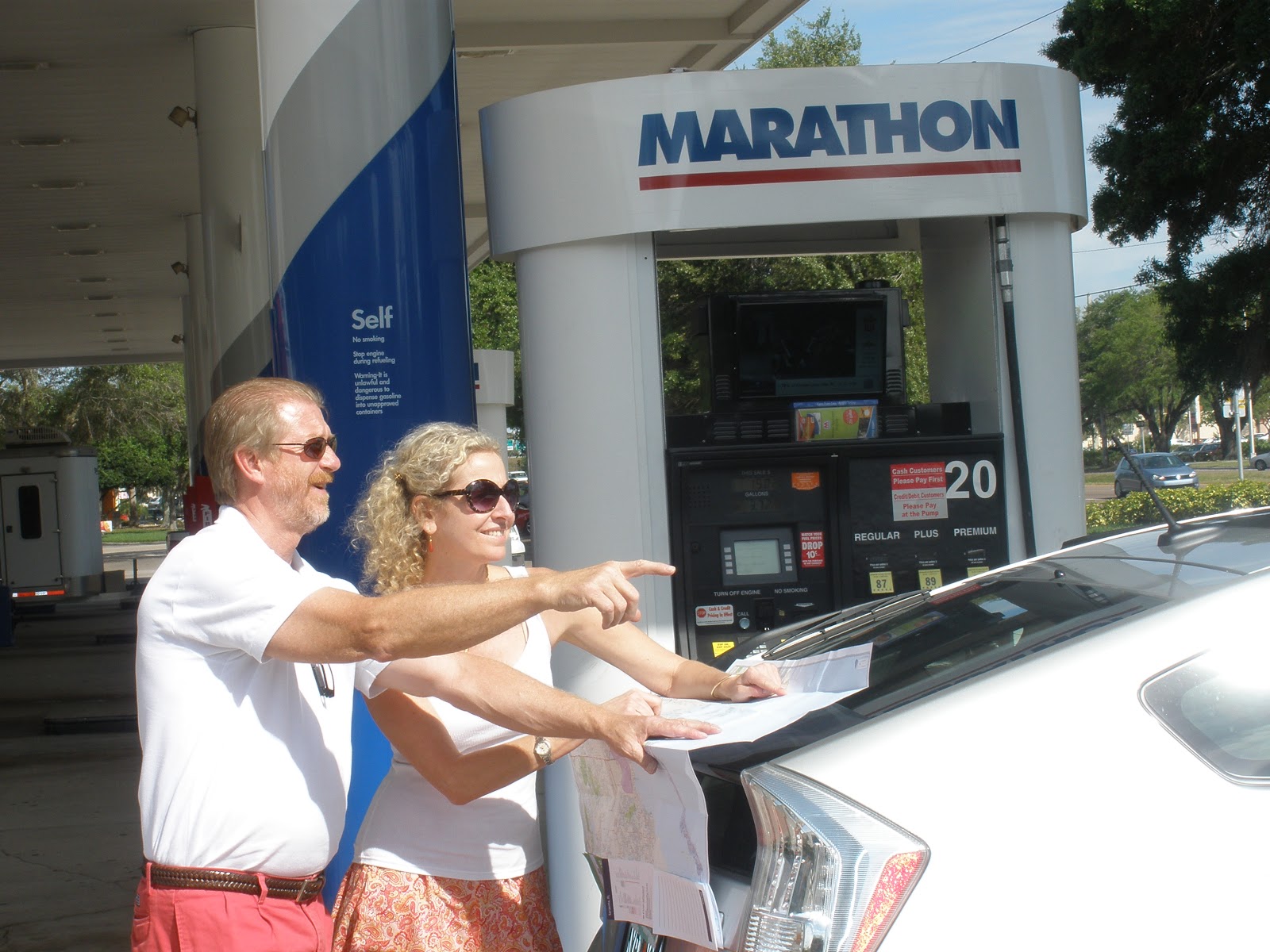
I also feel chagrined.  If there are people who can easily accommodate an intellectual map of an entire, expanding universe in their personal worldview, why am I incapable of finding Lakewood Ranch without having to befriend strangers at a gas station? 

In these moments, even GPS is not my friend. It lies and takes me to roads that no longer exist or never did.  A sense of deep panic rises within me when I am lost.  Circling around streets I should already know, I begin to accept that I will never reach my destination.

It’s not easy being directionally challenged. And forget about understanding dark energy or even basic electricity for that matter. Where was I during high school Science?  I have the poor grades to show that I actually took these classes, but can’t seem to remember anything from them except the fervent wish that the teacher never look in my direction.

Since maps are out, I’ve been rethinking the GPS approach. Recently I drove with a friend whose GPS speaks in Spanish. It seemed to give a lot more detail than mine and I like accented Sarasota destinations: San Ahrmond Searcle.  I think I’ll get one of those.  If nothing else, when I get lost next time, maybe I can alleviate the stress by brushing up on my Spanish skills.

Please read by other blog: http://whatdogsreallythink.blogspot.com/

"The Power of Wow" for Sarasota Visual Art

http://sarasotavisualart.com/


Home » ARTdart: The Power of Wow by Pamela Beck

ARTdart: The Power of Wow by Pamela Beck

ARTdart: There are as many ways to think about art as there are to create it. Join Pamela Beck in her new column, ARTdart, as she explores and considers the different perspectives that define the art world.

Pamela Beck
by Pamela Beck
When I was a young child, my mother took painting classes every Wednesday night at the local Y. Most of the time our lives were filled with the usual activities of family life, but when my mother returned from her art class, something in the air was always charged and different.
She would talk animatedly about what she had learned. I remember thinking how much younger she looked at those moments. I was too little to know what that sea change was all about on those nights, but I certainly felt it.
Later on, I realized that those evenings had been my introduction to the idea that art can inspire. And although I didn’t know what to call inspiration back then, I instinctively understood why people would want to seek the glow that I saw in my mother’s eyes.
If artists are often inspired by their work, it’s also one of the chief reasons people choose to spend their free time looking at it. Who doesn’t want to briefly put aside ordinary concerns and be entertained, stimulated and, if you’re lucky, inspired? And inspiration’s not easy to find these days, just check your local news.
When I go to a gallery or museum, I’m hoping for that “wow” moment that inspires me. It’s always a surprise and comes when I feel a rush of exhilaration or heightened awareness in reaction to what I see. Usually this happens when I find the art to be original or when the artist’s technique and talent strikes me. It’s a stop-time moment, when the art has reeled me in through its’ power, appearance and/or message.
I’d be hard pressed to explain the source of inspiration for an artist or an audience. But I do know that art can be a door to the unconscious where inspiration often resides. It can be liberating and moving to witness what’s behind that opened door: the freedom of an artist’s unrestrained ideas spread out across the playing field of art, without concern for the propriety or justification that usually defines our lives.
Of course, people enjoy art for many reasons without necessarily being inspired by it; just as artists don’t necessarily feel inspired each time they make something. Frankly, the arrival of inspiration is unpredictable anyway for both the artist and the viewer.
But sometimes, when you’re looking at a piece or creating it, things start to resonate within you in a personal way that’s difficult to describe. You may feel jazzed, in sync, uplifted and/or understood (and those reactions seep in and linger on afterwards).
At those moments, it’s hard to deny the power and allure of inspiration, as I first learned many years ago with my mother. Even if it only makes a brief appearance, the anticipation of finding inspiration once again, keeps you coming back to the source for more.


Please read by other blog:http://whatdogsreallythink.blogspot.com/
For Sarasota Visual Art, visit http://sarasotavisualart.com/
Wednesday, July 25, 2012

Need an Extra Kidney?


     Recently my Colombian friend, Rocio, and I brought my ailing poodle to the Sarasota clinic of veterinarian Dr. K (as his office staff calls him).  Even though I know he shortened his name because the longer version is too ethnic for anybody to pronounce correctly, I can’t stop making the connection to another more notorious Dr. K.  You know the one- the man equally revered and despised the world over, but forever connected to the sobriquet “Dr. Death.”

       Now my Dr. K, local healer of Sarasota puppies, is a very sweet man.  From the many recommendations I’ve received about him, he’s also a great vet with obviously no connection to the other Dr.K whatsoever.  But I’m a sensitive sort with a vivid imagination so when I had to leave my dog for a minor procedure with him, I required some sustenance.

     “What you need is a pandebono; it’s delicioso,” Rocio suggested when she saw the color drain from my face outside the doctor’s office. “No, what I need is a vodka tonic, immediatemente,” I replied. (Although I’d have been game for a pandebono if I'd known what it was.)  Rocio is a dear old friend of mine, so when she said I needed a pandebono, I listened.  We jumped in the car and headed to the Latin food market and restaurant Mi Sitio, on Webber and Beneva.  Neither of us had ever been there before, but when we entered, we were greeted warmly by the owner, Juan.

     Before getting down to the purpose of our visit, Rocio and Juan, complete strangers five minutes earlier, discussed towns they mutually knew in Colombia, favorite family recipes they loved and the location of Sarasota’s bilingual churches.  Enough already, you two; what of the elusive pandebono?

     There they were: small rolls sitting on the counter looking like plain fat dumplings. “It’s the Colombian bagel!” Rocio exclaimed persuasively when she saw my nonplussed reaction. She knew I thought a bagel with a shmear is one of life’s greatest gifts, so who was I to say no to a pandebono?  We bought two of the cheese filled delicacies  (a tasty reminder of the wise adage not to judge a book by its cover) and sat down at the counter to eat them with their customary chaser of hot chocolate.

     Soon we were joined in lively conversation by other Colombian and Cuban customers in the market. By the end of our snack, I swear they would have donated their kidneys to each other if one of them had asked. Eventually, Rocio and I, full and contented, returned to liberate my dog from Dr. K’s clutches and found the pup happy, calm and healthy.

     The curative power of a pandebono got me thinking about how most of us living in Sarasota started off in other states and are now, far from the comfort foods of our childhoods. If Rocio could find a Colombian pandebono in Sarasota, then I could find a real New York Bagel in this town as well.

     After some unsuccessful attempts I was directed to the Lox n’ Egg on 41. Upon entering the restaurant, the delicious smell of freshly baked bagels brought me back to Sunday mornings as a child in the city.  Back in the day, my father would rise early to buy the bagels, lox and whitefish my family devoured for breakfast while we read the multi sectioned treasure known as the Sunday New York Times.  If there is such a thing as heaven, that was it.

     Scattered between the noisy tables of happy diners at Lox n’ Egg, I could easily spot the look of need in a handful of solo diners.  One man in particular had it bad.  He stared at his bagel as he brought it ever so carefully to his waiting mouth.  I took a gamble and asked “Is it as good as H & H bagels in Manhattan?”  He tore his eyes away from his food abruptly and stared at me as if I were his long lost sister. “You wouldn’t believe that these bagels here are just as good as those!” he replied with a big smile. “You’ve gotta’ try them. My other New York friends meet me here on Sundays and we get every type, although my favorite is poppy seed.  Get your order and sit with me,” he continued. “I wanna’ hear your opinion.”

     He was right; the poppy seed was the best.  I didn’t think life in Sarasota could get much better, but come on, everybody needs their own pandebono when the chips are down (or you’re afraid your Dr. is a psychopath).  I told my new friend that I’d try to stop by occasionally to meet the group for Sunday bagels.  But now that I’ve experienced the joy and camaraderie a pandebono can bring, I'll be returning there quite often.

And let's face it, while the merits of a New York bagel are significant, you just never know when your number comes up and you might find yourself in dire need of an organ transplant.  Those pandebonos are looking better and better.

Please read by other blog:http://whatdogsreallythink.blogspot.com/http://whatdogsreallythink.blogspot.com/